You’ve booked your flights to Siem Reap. You’ve secured your hotel, mapped out your temple itinerary, and purchased your Angkor Pass. But now you’re staring at one of the most common dilemmas every traveler faces before visiting Cambodia’s crown jewel:
“Should I hire a private guide for Angkor Wat — or just explore on my own?” 🤔
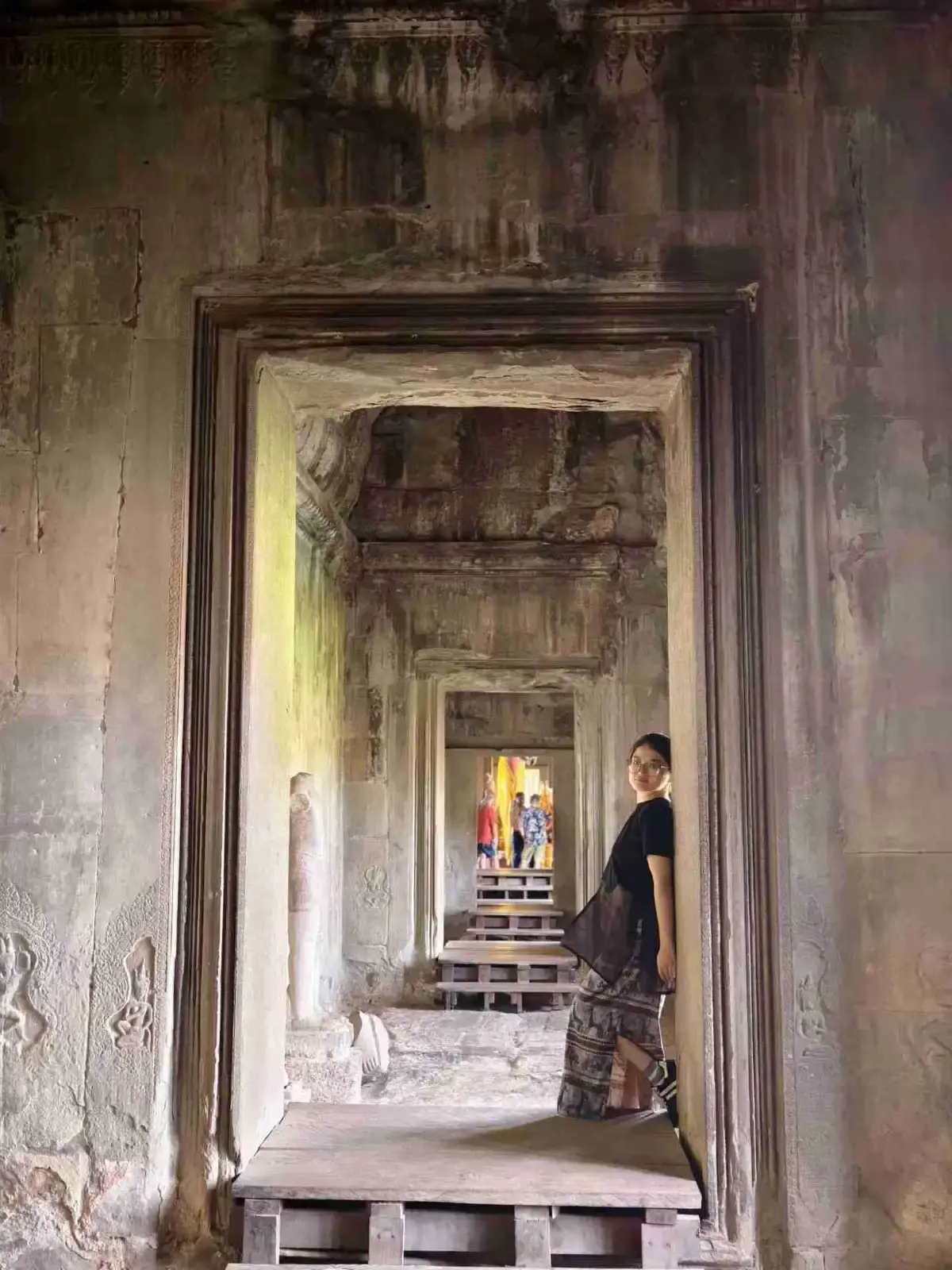
Walk through the ancient corridors of Angkor Wat at 6:00 AM, and you’ll see two types of visitors. The first group wanders silently through the galleries, snapping photos of the bas-reliefs, squinting at the carvings, and wondering what on earth they’re looking at. The second group huddles around a smiling Cambodian guide who points at a tiny carved figure and says, “This is Apsara, the celestial dancer. Notice how her fingers are positioned — each gesture tells a different story from the Ramayana…”
One group sees beautiful old rocks. The other group steps into a living, breathing 900-year-old civilization.
The difference? A guide.
But here’s the catch — guides cost money. And when you’re already budgeting for flights, hotels, temple passes, and tuk-tuks, adding another expense requires careful thought.
This comprehensive guide breaks down everything you need to know about hiring a private guide at Angkor Wat: the pros, the cons, the real costs, the alternatives, and — most importantly — whether it’s actually worth it for your specific trip. Let’s dive in. 🇰🇭✨
🏛️ What Does an Angkor Wat Guide Actually Do?
Before we weigh the pros and cons, let’s understand what a guide actually provides. A licensed Angkor guide is not simply a person who walks beside you and points at things. They are trained, certified professionals who have passed rigorous examinations on Khmer history, Hindu and Buddhist mythology, architecture, and conservation.
🎓 What a Licensed Guide Provides:
- 📜 Historical Context: They explain who built each temple, when, and why — transforming anonymous stone structures into stories of kings, wars, and devotion.
- 🕉️ Mythological Storytelling: They decode the bas-reliefs, explaining scenes from the Ramayana, the Mahabharata, and the Churning of the Ocean of Milk.
- 🏗️ Architectural Insight: They point out engineering marvels — how massive sandstone blocks were transported without wheels, how the moat system worked, why certain temples face west.
- 📸 Photo Guidance: They know the best angles, the hidden corridors with zero crowds, and the exact time the light hits a specific carving perfectly.
- ⏱️ Time Management: They optimize your route to avoid peak crowd times and get you to the best spots before the tour buses arrive.
- 🙏 Cultural Mediation: They explain temple etiquette, help you interact respectfully with monks, and navigate local customs.
- 🌿 Hidden Gems: They take you to lesser-known temples, secret viewpoints, and quiet corners that 99% of tourists never find.
💡 Key Insight: A guide doesn’t just show you Angkor Wat. They translate it. Without context, the world’s largest religious monument is visually stunning but intellectually silent. With a guide, every wall speaks.
👥 Types of Guides Available at Angkor Wat
Not all guides are created equal. Understanding your options is the first step to making an informed decision.
1. 🏛️ Official Licensed Guides (Government-Certified)
- What they are: Guides who have passed the official Cambodian Ministry of Tourism examination and hold a government-issued license.
- Languages available: English, French, German, Spanish, Italian, Japanese, Korean, Chinese, Russian, and more.
- How to identify them: They carry an official guide badge/license and are usually stationed at the Angkor Enterprise ticket center or arranged through hotels.
- Quality: Generally very high. They have deep knowledge and follow a structured narrative.
2. 🛺 Tuk-Tuk Driver Guides
- What they are: Your tuk-tuk driver who doubles as a casual guide. They know the routes, the best timing, and basic history.
- Pros: Free or very cheap (included in your tuk-tuk fare), friendly, flexible.
- Cons: Limited historical depth. They can tell you where to go but not always what you’re looking at.
- Best for: Budget travelers who want navigation help but don’t need deep commentary.
3. 📱 Audio Guides & Apps
- What they are: Pre-recorded audio tours you listen to on your phone or a rented device.
- Pros: Self-paced, affordable, available in multiple languages.
- Cons: No interaction, no ability to ask questions, no route optimization, no “hidden gem” flexibility.
- Best for: Solo travelers on a tight budget who want basic context.
4. 📚 Guidebooks & Offline Resources
- What they are: Books like “Angkor: An Introduction” by Maurice Glaize or offline Wikipedia downloads.
- Pros: Free or cheap, you can read at your own pace.
- Cons: Dry, academic, no visual pointing, easy to get lost in the text while standing in the sun.
- Best for: History enthusiasts who want to self-study before and during the visit.
5. 👨👩👧👦 Private Tour Company Guides
- What they are: Guides arranged through tour operators, often bundled with transportation, meals, and a fixed itinerary.
- Pros: All-inclusive convenience, professional service, often includes hotel pickup.
- Cons: More expensive, less flexibility, can feel rushed or “packaged.”
- Best for: Travelers who want zero logistical planning.
✅ PROS: Why Hiring a Private Guide is Worth It
Let’s lay out the compelling arguments FOR hiring a guide. These are the reasons thousands of travelers walk away saying, “It was the best money I spent in Cambodia.”
🏆 Pro #1: You’ll Understand What You’re Looking At
This is the single biggest advantage. Angkor Wat’s bas-reliefs stretch for nearly 600 meters. They depict the Churning of the Ocean of Milk, the Battle of Lanka, scenes of heaven and hell, and processions of King Suryavarman II’s army.
Without a guide, you see: “A long wall with lots of little carved people.” With a guide, you hear: “This section shows the army of Siam — notice they have different hairstyles and clothing from the Khmer soldiers. And here, Vishnu is churning the ocean using the serpent Vasuki as a rope…”
The carvings go from decoration to narrative. The temple goes from a building to a book. 📖
🏆 Pro #2: You’ll Save Time and Avoid Crowds
A good guide knows the rhythm of the park. They know that at 8:30 AM, the main gallery of Angkor Wat is flooded with tour groups, but the outer corridor is empty. They know that Ta Prohm gets mobbed by 10:00 AM, so they take you there at 7:15 AM when the light is golden and the tree roots are unobstructed.
Time saved: Easily 1–2 hours per day that you would have spent lost, confused, or stuck in crowds. ⏱️
🏆 Pro #3: You’ll Discover Hidden Gems
Every experienced guide has a repertoire of “secret spots” that aren’t on the standard tourist trail:
- A quiet courtyard where the light hits a devata carving at exactly 9:00 AM.
- A hidden doorway in Angkor Thom that leads to a stunning, empty viewpoint.
- A small, overlooked temple 500 meters off the main path where you’ll be the only visitor.
These are the moments that make your trip feel exclusive and magical. ✨
🏆 Pro #4: Better Photos
Guides know the angles. They’ll say, “Stand here, look up at this angle — see how the tower frames the sky?” or “Come to this window at 3:45 PM — the light will silhouette the columns perfectly.”
For anyone who cares about photography or Instagram-worthy shots, a guide is essentially a free photo director. 📸
🏆 Pro #5: Cultural Sensitivity and Etiquette
Cambodia is a deeply spiritual country. A guide ensures you don’t accidentally offend:
- They’ll remind you to remove shoes before entering sacred upper levels.
- They’ll explain how to behave around monks.
- They’ll translate if you want to ask a monk a respectful question.
- They’ll point out which areas are off-limits and why.
This is especially valuable for first-time visitors to Southeast Asia. 🙏
🏆 Pro #6: Safety and Navigation
The Angkor Archaeological Park covers over 400 square kilometers. Some paths are uneven, some temples have steep, crumbling staircases, and some areas are poorly signposted. A guide keeps you safe, points out hazardous steps, and ensures you don’t wander into restricted areas.
🏆 Pro #7: Supporting the Local Economy
Hiring a licensed Cambodian guide directly puts money into the hands of a local family. Many guides are passionate about sharing their heritage and take immense pride in their work. Your tip and positive review mean the world to them. 💚
🏆 Pro #8: You Can Ask Questions
This is the advantage no audio guide or book can match. You can stop your guide mid-sentence and ask:
- “Why is this temple facing west?”
- “What happened to the Khmer Empire after Angkor was abandoned?”
- “What does this symbol mean?”
- “How did they build this without modern tools?”
A live guide adapts to your curiosity. 🧠
❌ CONS: Why You Might Skip the Guide
To be balanced, let’s examine the legitimate reasons some travelers choose to explore without a guide.
⚠️ Con #1: Cost
This is the most common objection. A private guide adds a significant expense to your trip, especially for budget backpackers.
- If you’re traveling solo on $30/day, a $40 guide fee is more than your entire daily budget.
- For families of four, the cost multiplies quickly.
However, as we’ll discuss later, there are ways to share the cost or find budget-friendly options.
⚠️ Con #2: Loss of Spontaneity
Some travelers love the freedom of wandering without a plan. They want to sit on a stone ledge for 30 minutes and just feel the atmosphere. They want to duck into a random doorway and discover something on their own.
A guide, by nature, follows a narrative and a schedule. If you crave complete, unstructured freedom, a guide might feel restrictive.
⚠️ Con #3: Variable Quality
Not all guides are equally good. Some are phenomenal storytellers. Others are… not. You might get a guide who:
- Speaks with a heavy accent that’s hard to understand.
- Rushes through explanations.
- Recites memorized scripts without passion.
- Tries to steer you toward shops or restaurants for commission.
Mitigation: Read reviews, ask your hotel for recommendations, or request a specific guide by name.
⚠️ Con #4: Group Dynamics Can Be Awkward
If you hire a guide but are in a large group with differing interests, the guide may struggle to please everyone. One person wants deep history; another just wants photos. This can create friction.
⚠️ Con #5: You Might Feel “Led Around”
For experienced travelers who have already read extensively about Angkor, having someone narrate what you already know can feel redundant. If you’ve read three books on Khmer history before your trip, a guide’s value diminishes.
⚠️ Con #6: Language Barriers
While English-speaking guides are common, their fluency levels vary. Some are near-native; others have a functional but limited vocabulary. If you’re hoping for nuanced philosophical discussions, you might occasionally hit a language wall.
💰 How Much Does a Private Guide Actually Cost?
Let’s break down the real numbers so you can budget accurately.
📊 Official Guide Pricing (2024–2025 Estimates)
| Guide Type | Duration | Cost (USD) | Notes |
|---|---|---|---|
| Licensed English-speaking guide | Half day (4 hrs) | $25 – $35 | Covers one circuit |
| Licensed English-speaking guide | Full day (8 hrs) | $40 – $60 | Covers sunrise + full circuit |
| Licensed foreign-language guide (French, German, etc.) | Full day | $50 – $75 | Less common, higher demand |
| Tuk-tuk driver as casual guide | Full day | $15 – $25 | Navigation + basic info only |
| Private tour with guide + car | Full day | $80 – $150+ | All-inclusive package |
| Shared group guide | Half day | $5 – $15 per person | 4–8 people sharing |
💡 Additional Costs to Consider
- Tips: $5–$15 for a good guide is customary and deeply appreciated.
- Meals: If your guide joins you for lunch, it’s polite (but not mandatory) to buy their meal.
- Transportation: Guide fees are separate from tuk-tuk or car hire. You’ll pay both.
- Multi-day discount: If you book the same guide for 2–3 days, negotiate a package rate. Many guides will offer $10–$20 off the total.
🤔 Is the Price Justified?
Consider this: You’re spending $37–$72 on your Angkor Pass. Your flights cost hundreds (or thousands). Your hotel costs $30–$200/night.
A $40 guide transforms a $37 temple ticket from a “nice walk among old rocks” into a “once-in-a-lifetime journey through a lost civilization.”
The guide is the cheapest part of your trip with the highest impact on your experience. 💎
🔍 Guide vs. No Guide: What You’ll Actually Experience
Let’s paint two vivid scenarios for the same morning at Angkor Wat.
🚶 WITHOUT a Guide:
You arrive at 5:30 AM. It’s dark. You fumble toward the reflection pond with 200 other tourists. You take your sunrise photos. Then you enter the temple. You walk through the first gallery. The walls are covered in carvings. You think, “Wow, that’s a lot of carving.” You take a photo. You move on. You climb to the upper level. It’s steep. You take another photo. You leave after about 90 minutes, feeling a bit underwhelmed. You head to the next temple and repeat. By the 4th temple, everything looks the same.
🗣️ WITH a Guide:
Your guide, Sokha, meets you at 4:45 AM with a flashlight. “Follow me. I know a path where we’ll avoid the main crowd.” He leads you to a quieter section of the moat. As the sun rises, he whispers, “The Khmers aligned this temple so the equinox sun rises directly over the central tower. Watch.” You gasp.
Inside, he stops at a specific panel. “See this figure? This is Ravana shaking Mount Kailash. And here, Shiva is calming his wife Parvati. Notice her expression — she’s terrified. The sculptor captured emotion in stone 900 years ago.”
He takes you to a hidden window where the light creates a perfect silhouette. He tells you about the 15th-century abandonment of Angkor, the jungle swallowing the city, and the French rediscovery. By the time you leave, you don’t just feel like you saw Angkor Wat. You feel like you understood it. You feel connected to something ancient and profound.
That’s the difference. 🌟
🎯 When Is a Guide MOST Worth It?
A private guide isn’t equally valuable for every traveler. Here’s when the investment pays off the most:
✅ Hire a Guide If:
- 🆕 It’s your first time in Cambodia or Southeast Asia. The cultural and historical context will be completely foreign to you.
- 📜 You love history, mythology, or architecture. A guide will feed your curiosity endlessly.
- 📸 Photography is a priority. Guides know the light, the angles, and the empty spots.
- ⏱️ You’re short on time. A 1-day visitor needs a guide to maximize every minute.
- 👨👩👧👦 You’re traveling with children. A good storyteller keeps kids engaged and prevents “temple boredom.”
- 🧘 You want a deeper, spiritual experience. Guides can explain the Buddhist and Hindu rituals still practiced at the temples.
- 🌍 You’re visiting the lesser-known temples (Beng Mealea, Banteay Chhmar, Koh Ker). These sites have almost no signage, and a guide is essential.
❌ You Can Probably Skip a Guide If:
- 📚 You’ve done extensive research. If you’ve read 2–3 books on Angkor and Khmer history, you already know the narratives.
- 🎒 You’re on an ultra-tight budget. If $40 means skipping three meals, prioritize food and use a free audio guide app.
- 🧭 You’re an experienced temple-hopper. If you’ve explored Borobudur, Bagan, or Pagan extensively, the “wow factor” is familiar.
- 🚶 You want pure, unstructured wandering. If your goal is to sit quietly, sketch, meditate, or just be in the space, a guide’s commentary might interrupt your flow.
🛠️ How to Hire a GOOD Guide (Avoiding the Bad Ones)
Not all guides are created equal. Here’s how to ensure you get a fantastic one:
📋 Step-by-Step Hiring Guide:
Step 1: Ask Your Hotel 🏨 Most reputable Siem Reap hotels have relationships with 2–3 trusted guides. Ask the front desk: “Can you recommend a licensed English-speaking guide for tomorrow?” They’ll usually arrange it within hours.
Step 2: Check Credentials 🪪 A legitimate guide will have an official Ministry of Tourism license displayed on a lanyard or badge. Don’t be afraid to ask: “Are you a licensed guide?” A real guide will proudly show their credentials.
Step 3: Read Reviews or Ask for References ⭐ If booking through a tour company, check online reviews. If hiring independently, ask: “Have you guided travelers from my country before? Can you share a testimonial?”
Step 4: Discuss the Itinerary in Advance 🗺️ Before the day begins, tell your guide what you want:
- “I want to focus on photography.”
- “I’m most interested in Hindu mythology.”
- “I want to avoid crowds.”
- “I have limited mobility, so please avoid steep climbs.”
A good guide will customize the day based on your answers.
Step 5: Agree on Price and Duration Upfront 💵 Confirm:
- Total cost for the day.
- Whether it includes sunrise.
- Whether lunch is included.
- Whether tips are expected.
- Overtime charges if you run late.
Step 6: Trust Your Gut 🧭 If a guide feels pushy, disengaged, or more interested in steering you to shops than showing you temples, politely thank them and find someone else. You are paying for a service.
🚩 Red Flags to Watch Out For
Unfortunately, a small number of “guides” operate without licenses or with ulterior motives. Watch for these warning signs:
| 🚩 Red Flag | What It Means |
|---|---|
| No official license or badge | Unlicensed, potentially untrained |
| Pushes you to visit a specific shop or restaurant | They’re earning commission |
| Rushes through explanations | They want to finish early and take another client |
| Can’t answer basic historical questions | They memorized a script but lack real knowledge |
| Asks for full payment upfront before the tour | Risk of poor service or no-show |
| Speaks very limited English despite claiming fluency | Communication will be frustrating |
| Tries to change the itinerary without asking | They may be avoiding certain areas or adding paid stops |
⚠️ If something feels off, trust your instincts. Politely end the tour and report the issue to your hotel or the tourism authority.
🎧 Alternatives to a Private Guide
If a private guide doesn’t fit your budget or style, here are solid alternatives:
📱 Option 1: Audio Guide Apps
- Rick Steves Audio Europe: Offers a free Angkor Wat audio tour.
- VoiceMap / Echoes: GPS-triggered audio tours that narrate as you walk.
- Cost: Free to $5.
- Best for: Solo travelers who want basic context without spending $40.
📖 Option 2: Guidebooks
- “Angkor: An Introduction” by Maurice Glaize — the classic reference.
- “The Ancient Khmer Empire” by Michael Coe — deeper historical context.
- Cost: $10–$20.
- Best for: Readers who want to self-study before and during the visit.
🤝 Option 3: Shared Group Guides
- Many tour operators offer small-group guided tours (6–10 people) at a fraction of the private guide cost.
- Cost: $10–$20 per person.
- Best for: Solo travelers or couples who want guide knowledge without the private price tag.
🛺 Option 4: Tuk-Tuk Driver with Basic Knowledge
- Many experienced tuk-tuk drivers know the park intimately and can provide basic historical context.
- They won’t decode bas-reliefs, but they’ll get you to the right places at the right times.
- Cost: Included in your $15–$25/day tuk-tuk fare.
- Best for: Budget travelers who prioritize navigation over narration.
🏛️ Option 5: On-Site Information Boards
- Major temples have informational placards at entrances.
- Cost: Free.
- Best for: Quick reference, but very limited in depth.
❓ Questions to Ask Before Hiring a Guide
Print this list or save it on your phone. When interviewing a potential guide, ask:
- 🪪 “Are you a licensed guide? Can I see your credentials?”
- 🗣️ “What languages do you speak fluently?”
- ⏱️ “How many hours does the tour cover? Does it include sunrise?”
- 🗺️ “Can we customize the itinerary? I really want to see [specific temple].”
- 📸 “Do you know good photo spots and times?”
- 💵 “What is the total cost? Is tipping included or separate?”
- 🍜 “Will we stop for lunch? Where?”
- 🚗 “Do you work with a tuk-tuk driver, or do I arrange transport separately?”
- 👥 “How many people will be in the group?” (If it’s a shared tour)
- 🔄 “What happens if it rains heavily?”
✅ A great guide will answer all of these confidently, warmly, and without hesitation.
💬 What Travelers Say: Real Experiences
Here’s a synthesis of common feedback from travelers who’ve made the decision:
👍 Those Who Hired a Guide Said:
- “Our guide Sokha made the carvings come alive. I cried at the Bayon. I would have walked right past those faces without understanding them.”
- “He took us to a hidden courtyard where we were completely alone for 20 minutes. Best photos of the entire trip.”
- “Worth every penny. I learned more in one day than I would have in a week of reading.”
- “Our kids were bored until the guide started telling stories about the gods. Suddenly they were asking questions.”
👎 Those Who Skipped a Guide Said:
- “I regret it. I spent 4 hours walking around feeling like I was missing the whole point.”
- “I saved $40 but felt like I wasted my $37 temple ticket.”
- “I used an audio guide app, but it was dry and I couldn’t ask questions.”
🤝 Those Who Used Alternatives Said:
- “The shared group guide was great value. $12 for 4 hours of excellent commentary.”
- “My tuk-tuk driver wasn’t a ‘guide,’ but he knew exactly when to hit each temple to avoid crowds. That alone was worth it.”
🏁 The Final Verdict: Is It Worth It?
After weighing every pro, every con, and every dollar, here’s the honest answer:
🟢 YES, hire a private guide if:
- It’s your first time at Angkor.
- You want to understand, not just see.
- You’re short on time (1–2 days).
- You value storytelling, photography, and hidden gems.
- You can comfortably afford the $25–$60 without sacrificing meals or safety.
🟡 CONSIDER a shared guide or audio app if:
- You’re on a moderate budget.
- You want some context but don’t need a private experience.
- You’re comfortable with a group of 4–8 people.
🔴 SKIP the guide if:
- You’re on an extremely tight budget (under $25/day total).
- You’ve done deep research and already know the history.
- Your primary goal is solitude, meditation, or sketching.
- You’re a repeat visitor who’s already had a guide before.
💎 The Bottom Line:
For the vast majority of first-time visitors, hiring a licensed private guide is the single best investment you can make in your Angkor Wat experience. It’s the difference between looking at a 900-year-old wall and reading it. Between taking a photo and understanding what you photographed. Between visiting a place and connecting with it.
The temples will stand for another thousand years. But your trip is happening now. Make it count. 🌅
❓ Frequently Asked Questions (FAQs)
Q: How much should I tip my Angkor Wat guide? A: $5–$15 USD is standard for a full-day guide. For exceptional service, $20+ is generous. Tips are deeply appreciated and often support the guide’s entire family.
Q: Can I hire a guide on the spot at the temple? A: Yes, licensed guides are available near the Angkor Enterprise ticket center and at major temple entrances. However, pre-booking through your hotel ensures better quality and availability.
Q: Do I need a separate guide for each temple? A: No. One guide covers the entire Archaeological Park for the day. They’ll accompany you from Angkor Wat to Bayon to Ta Prohm and beyond.
Q: Are guides available in languages other than English? A: Yes. French, German, Spanish, Italian, Japanese, Korean, Chinese, Russian, and Thai guides are available, though they may cost slightly more due to lower supply.
Q: Can I negotiate the guide’s price? A: For multi-day bookings (2–3 days), you can negotiate a package discount. For single-day rates, the price is generally fixed, especially for licensed guides.
Q: Will the guide take my photo? A: Most guides are happy to take photos for you, and they often know the best angles. However, they are not professional photographers. Bring your own camera or phone.
Q: What if I don’t like my guide? A: Politely thank them at the next temple and arrange a replacement through your hotel or tour operator. You should not feel obligated to stay with a guide who isn’t meeting your expectations.
Q: Is it safe to hire a freelance guide? A: Generally, yes. However, always verify their license. Booking through your hotel or a reputable tour operator adds a layer of accountability and safety.
Q: Do guides work in the rain? A: Yes. Most guides operate rain or shine. Bring a lightweight poncho. The rain often clears the crowds, making for a magical, atmospheric experience.
Q: Can I request a female guide? A: Yes, female guides are available. Specify your preference when booking through your hotel or tour operator.
🌟 Final Thoughts
Angkor Wat is not just a tourist attraction. It is the spiritual and cultural heart of Cambodia. It is the legacy of an empire that once ruled much of Southeast Asia. It is a place where stone whispers stories of gods, kings, and devotion.
You can walk through those ancient corridors in silence, taking photos and moving on. Or you can have someone beside you who says, “Look here. See this tiny carving? This is where the sculptor hid his signature. He wanted someone, 900 years from now, to know he was here.”
That’s what a guide gives you. Not just information. Connection.
So yes, hire the guide. Budget for it. Prioritize it. And when your guide points at a weathered stone face and tells you the story behind the smile, you’ll understand exactly why it was worth every single dollar. 🇰🇭✨
📌 Found this guide helpful? Save it for your trip planning, share it with your travel buddy, and start building your perfect Angkor Wat itinerary today!