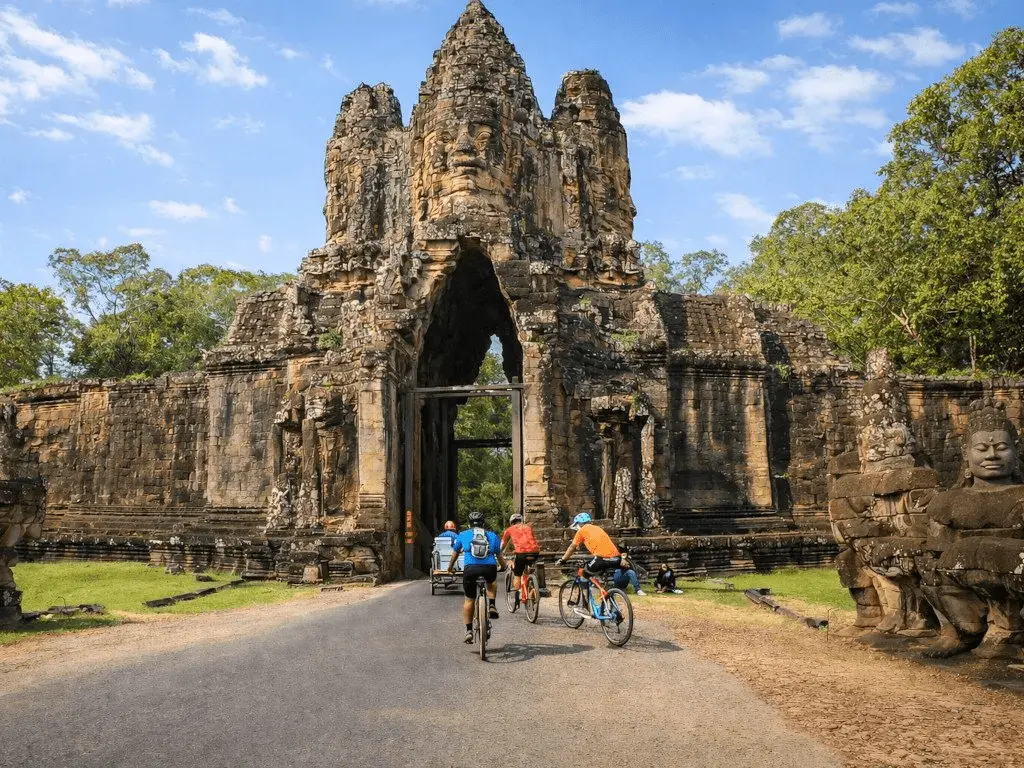
You’ve booked your flights to Siem Reap. You’ve secured your Angkor Pass. You’ve researched the temples until you can recite the history of Suryavarman II in your sleep. But there’s one critical question that catches almost every first-time visitor off guard:
“How do I actually get between the temples?” 🤔
Here’s the reality that no pretty Instagram photo shows you: The Angkor Archaeological Park is not a single location. It is a sprawling 400-square-kilometer UNESCO World Heritage Site containing dozens of major temple complexes, ancient reservoirs, jungle paths, and crumbling ruins. The distance between Angkor Wat and Ta Prohm alone is roughly 5 kilometers. The Grand Circuit spans over 26 kilometers.
You cannot simply stroll from temple to temple the way you’d wander between monuments in a European capital. The tropical heat, the uneven terrain, and the sheer distances make walking between major sites impractical — and potentially dangerous.
So, how do you conquer this ancient wonderland? You have three main champions in the arena: the iconic Tuk-Tuk, the humble Bicycle, and the modern E-Bike. Each has its loyalists, its strengths, and its weaknesses.
This definitive guide breaks down every transportation option available at Angkor Archaeological Park — costs, routes, pros, cons, and insider tips — so you can choose the perfect ride for your budget, fitness level, and travel style. Let’s roll! 🇰🇭✨
🗺️ Understanding the Angkor Archaeological Park Layout
Before choosing your transport, you need to understand the terrain you’ll be navigating.
📏 The Two Main Circuits
The park is organized into two primary touring loops:
| Circuit | Total Distance | Key Temples | Time Needed |
|---|---|---|---|
| Small Circuit 🟢 | ~17 km | Angkor Wat, Angkor Thom (Bayon), Ta Prohm, Banteay Kdei | 6–8 hours |
| Grand Circuit 🔵 | ~26 km | Preah Khan, Neak Pean, Ta Som, East Mebon, Pre Rup | 6–8 hours |
🌡️ The Climate Factor
- Dry Season (Nov–Feb): Temperatures hover around 25–32°C. Cycling is manageable if you start early.
- Hot Season (Mar–May): Temperatures spike to 35–42°C. Cycling becomes genuinely dangerous without extreme caution.
- Wet Season (Jun–Oct): Afternoon downpours flood some roads. E-bikes and tuk-tuks handle this better than bicycles.
🛤️ Road Conditions
- The main roads connecting temples are paved and relatively smooth.
- Some secondary paths (especially around the Grand Circuit) are gravel, dirt, or sandy.
- There are no dedicated bicycle lanes. You share the road with tuk-tuks, cars, tour buses, and motorcycles.
💡 Key Insight: The Small Circuit is flat and well-paved — perfect for all transport types. The Grand Circuit has rougher patches and longer distances, favoring motorized transport or e-bikes.
🛺 Option 1: The Tuk-Tuk (The Classic Choice)
The tuk-tuk is the undisputed king of Angkor transportation. If you close your eyes and picture a traveler exploring Angkor Wat, they’re almost certainly bouncing along in the back of a colorful, open-air tuk-tuk.
🚗 What is a Tuk-Tuk?
A tuk-tuk in Siem Reap is a motorized three-wheeled vehicle (or a motorcycle pulling a small enclosed carriage) that seats 2–4 passengers comfortably. It has no air conditioning, no doors, and no seatbelts — just a bench seat, a canvas roof for sun/rain protection, and the open jungle breeze.
💰 Cost Breakdown
| Duration | Small Circuit | Grand Circuit | Full Day (Both) |
|---|---|---|---|
| Solo Traveler | $12–$15 | $15–$20 | $18–$25 |
| 2 People | $15–$18 | $18–$22 | $20–$28 |
| 3–4 People | $18–$20 | $20–$25 | $25–$30 |
| Sunrise Add-On | +$3–$5 | +$3–$5 | +$3–$5 |
Prices are negotiable. Always agree on the total price BEFORE the ride starts.
✅ PROS of the Tuk-Tuk
1. 🛋️ Zero Physical Effort You sit. The driver does the work. After climbing 300 steep stone steps at Bayon, the last thing you want to do is pedal 5 kilometers to Ta Prohm. The tuk-tuk lets you conserve energy for exploring, not commuting.
2. 🧳 Your Personal Base Camp Your tuk-tuk driver waits at each temple entrance. The vehicle becomes your mobile locker — you can leave your daypack, water bottles, sunscreen, and purchases in the seat while you explore hands-free.
3. 🌧️ Weather Protection The canvas roof shields you from the brutal midday sun and the sudden wet-season downpours. Bicycles and e-bikes offer zero protection.
4. 🗣️ Built-In Local Guide Most experienced tuk-tuk drivers know the park like the back of their hand. They’ll advise you on:
- Which temple to visit first to beat the crowds.
- Where the best (and cheapest) lunch spots are.
- Which paths are flooded or under renovation.
- The best photo angles and timing.
5. 💧 Free Perks Many drivers provide complimentary cold water bottles and wet towels throughout the day. This alone saves you $3–$5 in overpriced temple-area water.
6. 👨👩👧👦 Perfect for Groups and Families Splitting a tuk-tuk among 3–4 people brings the cost down to $5–$8 per person per day. For families with children or elderly travelers, it’s the only sensible option.
7. 🌅 Sunrise Made Easy Your driver picks you up from your hotel at 4:30 AM, navigates the dark roads, and drops you right at the reflection pond. No fumbling with bicycle lights or e-bike batteries in the pitch black.
❌ CONS of the Tuk-Tuk
1. 🐢 You’re at the Driver’s Pace You can’t spontaneously stop to photograph a beautiful tree, a monkey, or a hidden doorway. You follow the driver’s route. If you want to linger somewhere for 45 minutes while the driver is ready to move on, it can create awkwardness.
2. 📱 No “Off the Beaten Path” Access Tuk-tuks are limited to paved or well-maintained roads. They can’t navigate the narrow jungle trails or sandy paths that bicycles and e-bikes can sometimes access.
3. 💨 Dust and Exhaust Sitting in the back of a tuk-tuk on a dry, dusty road behind a tour bus means breathing in fumes and red dust. Bring a scarf or buff to cover your nose and mouth.
4. 🌡️ Heat Buildup While the canvas roof blocks direct sun, the enclosed sides can trap heat, making the back of the tuk-tuk feel like a mini oven in April/May.
5. 📶 No Exercise For travelers who enjoy staying active, the tuk-tuk removes the physical engagement of cycling. You miss the visceral feeling of pedaling through jungle canopy.
📋 How to Hire a Tuk-Tuk Driver
Step 1: Ask Your Hotel 🏨 Most hotels and hostels in Siem Reap have 2–3 trusted tuk-tuk drivers they work with regularly. This is the safest and most reliable option. The hotel can negotiate the price and confirm the itinerary for you.
Step 2: Negotiate Directly 🤝 If you find a driver on the street or near the Old Market:
- Agree on the total price for the day (not per temple).
- Confirm which circuit you’ll cover (Small, Grand, or both).
- Confirm if sunrise is included or costs extra.
- Confirm the pickup time and pickup location.
- Get their phone number (WhatsApp is widely used).
Step 3: Multi-Day Booking 📅 If you have a 3-Day Angkor Pass, book the same driver for all three days. They’ll often give you a $5–$10 discount on the total, and you’ll build a comfortable rapport.
🎯 Best For:
- Families with children 👨👩👧👦
- Elderly travelers or those with mobility issues 🦽
- First-time visitors who want zero logistical stress 🆕
- Groups of 3–4 splitting costs 👥
- Anyone visiting during the scorching months of April/May 🥵
- Photography-focused travelers who want energy for shooting, not pedaling 📸
🚲 Option 2: The Bicycle (The Adventurer’s Choice)
For the fitness enthusiast, the budget backpacker, or the traveler who craves maximum freedom, the humble bicycle is a magical way to experience Angkor.
💰 Cost
| Rental Period | Price |
|---|---|
| Half Day | $2–$3 |
| Full Day | $3–$5 |
| Multi-Day (2–3 days) | $5–$10 total |
Available at virtually every guesthouse, hostel, hotel, and rental shop in Siem Reap.
✅ PROS of the Bicycle
1. 🦅 Ultimate Freedom You are the captain of your journey. Want to stop at a random jungle clearing? Stop. Want to sit on a stone wall and watch the clouds for 20 minutes? Do it. Want to take a detour down a mysterious dirt path? Go for it. No driver, no schedule, no waiting.
2. 💸 Unbeatable Price At $3–$5 per day, the bicycle is the cheapest motorized-free transport option available. For budget travelers, this is a no-brainer.
3. 🌿 Immersive Experience Cycling through the jungle roads between temples, you hear the birds, feel the breeze, smell the frangipani flowers, and pass through small villages. You experience the landscape of Angkor, not just the buildings.
4. 🏋️ Built-In Exercise You’ll burn 400–600 calories cycling the Small Circuit. After a week of eating Khmer curry and mango sticky rice, your body will thank you.
5. 📸 Better Photo Opportunities On a bicycle, you can pull over anywhere to capture a photo. No asking the driver to stop. No feeling rushed. You set the rhythm.
6. 🤫 Quieter and More Peaceful No engine noise, no exhaust fumes. Just the sound of tires on gravel and birdsong in the canopy.
❌ CONS of the Bicycle
1. 🥵 The Heat is BRUTAL This cannot be overstated. Cycling 17–26 km under the Cambodian sun, especially from March to May, is genuinely dangerous. Heatstroke, dehydration, and sunburn are real risks.
- Mitigation: Start at 5:00 AM. Take breaks every 45 minutes. Drink 3+ liters of water. Wear a hat and sunscreen.
2. 💪 Fitness Requirement The Small Circuit is manageable for anyone with basic fitness. The Grand Circuit (26 km on mixed terrain) requires a moderate level of stamina. If you haven’t cycled in years, this will be a struggle.
3. 🛤️ Terrain Challenges Some sections of the Grand Circuit are sandy, gravelly, or have potholes. A standard rental bicycle (usually a basic mountain bike or city bike) handles these poorly. You’ll be bouncing and struggling.
4. 🌧️ No Weather Protection If it rains (especially June–October), you will get soaked. There is no shelter on a bicycle. A sudden downpour can make roads slippery and dangerous.
5. 🔦 Dangerous in the Dark If you’re cycling to the temple for a 5:00 AM sunrise, you’ll be riding in pitch blackness on roads shared with tuk-tuks and motorcycles. Most rental bikes have poor or broken lights.
- Mitigation: Bring your own headlamp or clip-on bike light. Wear reflective clothing.
6. 🚫 No Storage You carry everything on your back. Water bottles, sunscreen, camera, phone, snacks — it all goes in your daypack. This adds weight and increases sweating.
7. ⏱️ Slower Pace Cycling between temples takes 15–25 minutes per leg. A tuk-tuk covers the same distance in 5–8 minutes. Over a full day, you lose 1–2 hours of exploration time to transit.
📋 Tips for Cycling Angkor
- 🚲 Test the bike before renting. Check the brakes, tires, gears, and seat height. Many rental bikes are old and poorly maintained.
- 🪖 Wear a helmet. Rental shops usually provide one (often for free). Don’t skip it.
- 🗺️ Download an offline map (Maps.me or Google Maps offline). Some jungle paths are confusing.
- 💧 Carry at least 2 liters of water. Buy them at a supermarket in town ($0.50/bottle), not at the temples ($2–$3/bottle).
- 🧴 Apply sunscreen BEFORE you start. Reapply every 2 hours. The sun is relentless.
- ⏰ Start by 5:30 AM. The earlier you start, the cooler the ride and the fewer the crowds.
- 🥤 Electrolytes are your friend. Add an electrolyte tablet to your water bottle to prevent cramping.
🎯 Best For:
- Budget backpackers 🎒
- Fitness enthusiasts and active travelers 🏃
- Solo travelers who want complete independence 🚶
- Photographers who want to stop anywhere 📷
- Visitors during the cool, dry months (Nov–Feb) ❄️
- The Small Circuit (manageable) — NOT recommended for the Grand Circuit without good fitness ⚠️
🔋 Option 3: The E-Bike (The Modern Sweet Spot)
The electric bicycle (e-bike) has exploded in popularity in Siem Reap over the last few years, and for good reason. It combines the freedom of cycling with the effortless glide of a motor.
💰 Cost
| Rental Period | Price |
|---|---|
| Half Day | $5–$7 |
| Full Day | $8–$12 |
| Multi-Day (2–3 days) | $15–$25 total |
Slightly more expensive than a bicycle, but significantly cheaper than a tuk-tuk.
⚡ How E-Bikes Work in Siem Reap
The e-bikes available for rent are typically scooter-style electric bikes (not pedal-assist bikes like you’d see in Europe). They have:
- A throttle (twist grip) — you don’t need to pedal at all.
- A range of 40–60 km on a full charge.
- A top speed of 25–35 km/h.
- A small basket at the front for your daypack.
- Basic suspension for rough roads.
✅ PROS of the E-Bike
1. ⚡ Effortless Exploration Twist the throttle and glide. You get all the freedom and open-air experience of a bicycle with zero physical exertion. No sweating through your shirt before you even reach the first temple.
2. 🌿 Same Immersive Experience as Cycling You’re still outdoors, feeling the breeze, hearing the jungle, and stopping wherever you want. The e-bike doesn’t isolate you like a car or tuk-tuk.
3. 🛤️ Handles Rough Terrain Better Most rental e-bikes have wider tires and small motors that handle gravel, sand, and mild potholes better than a standard bicycle. You can explore some of the rougher Grand Circuit paths without struggling.
4. ⏱️ Faster Than Cycling, More Flexible Than a Tuk-Tuk You cover distances quickly (25–30 km/h) but can still spontaneously pull over, take detours, and set your own pace. Best of both worlds.
5. 🌅 Sunrise-Friendly Unlike a bicycle, you don’t need to pedal in the dark. The e-bike’s headlight illuminates the road, and you arrive at the temple fresh, not drenched in pre-dawn sweat.
6. 💰 Great Value At $8–$12/day, it’s only slightly more than a bicycle but saves you enormous physical energy. For the Grand Circuit (26 km), it’s a game-changer.
7. 🎒 Decent Storage The front basket holds a small daypack. Some models have a rear rack for additional storage. Much better than carrying everything on your back.
❌ CONS of the E-Bike
1. 🔋 Battery Anxiety If you’re covering the Grand Circuit + extra detours, you might push the limits of the battery range (40–60 km). Running out of charge in the middle of the park is a nightmare.
- Mitigation: Confirm the battery is fully charged before you leave. Ask the rental shop about their roadside assistance policy. Plan your route to stay within range.
2. 🚦 Traffic Awareness Required You’ll be sharing the road with tuk-tuks, tour buses, and motorcycles. E-bikes are quiet, so other vehicles may not hear you coming. You need to be alert, use hand signals, and stay visible.
3. 🌧️ Still No Weather Protection Like the bicycle, you’re exposed to sun and rain. A wet-season downpour will soak you and potentially damage the e-bike’s electrical components.
4. ⚖️ Heavier and Harder to Maneuver E-bikes are heavier than bicycles. If the battery dies, pedaling an e-bike is significantly harder due to the extra weight.
5. 📜 No Official License Required, But Risk Exists You don’t need a driver’s license to rent an e-bike in Siem Reap. However, if you’re involved in an accident, travel insurance may not cover you if you were operating a motorized vehicle without a valid license. Check your policy.
6. 🔧 Mechanical Issues Rental e-bikes are often well-used. Flat tires, brake issues, and electrical glitches can happen mid-ride. Rent from a reputable shop and test the bike thoroughly before leaving.
📋 Tips for E-Bike Riders
- 🔋 Check the battery level before you leave. Ensure it’s at 100%.
- 🪖 Wear the helmet. E-bikes go faster than bicycles. A fall at 30 km/h on gravel is serious.
- 📱 Save the rental shop’s phone number. If the battery dies or the bike breaks down, you need a backup plan.
- 🗺️ Plan your route carefully. Know the total distance before you depart. Don’t add spontaneous detours if you’re near the battery limit.
- 🌧️ Avoid riding in heavy rain. Water can damage the motor and make roads dangerously slippery.
- 🐒 Watch for monkeys and dogs. They dart across roads without warning, especially near Angkor Thom.
🎯 Best For:
- Solo travelers and couples who want freedom without exhaustion 🚴♀️
- The Grand Circuit (long distances made easy) 🔵
- Budget travelers who want to save on tuk-tuk costs 💰
- Photography enthusiasts who want to stop anywhere 📸
- Travelers visiting during the cool, dry season ❄️
- Those who want the cycling experience without the sweat 🧘
🚗 Option 4: Private Car / Minivan (The Comfort Choice)
For travelers who prioritize comfort, air conditioning, and zero exposure to the elements, a private car or minivan is the premium option.
💰 Cost
| Vehicle | Duration | Price |
|---|---|---|
| Private Sedan (2–3 pax) | Full Day | $40–$60 |
| Private Minivan (4–8 pax) | Full Day | $60–$90 |
| Luxury SUV | Full Day | $80–$120+ |
Includes driver, fuel, and air conditioning. Does NOT include guide or meals.
✅ PROS
- ❄️ Air conditioning — a lifesaver in April/May heat.
- 🧳 Ample storage for bags, camera gear, and purchases.
- 👴 Ideal for elderly travelers or those with mobility challenges.
- 🌧️ Complete weather protection.
- 👨👩👧👦 Spacious for families with strollers, car seats, and snacks.
❌ CONS
- 💸 Most expensive option by far.
- 🚫 Limited parking access at some smaller temples. You may need to walk further from the car park.
- 🐢 Less flexible than a tuk-tuk or e-bike. Cars can’t navigate narrow paths.
- 🌿 Isolating experience. You’re sealed in a metal box, missing the sounds, smells, and breeze of the jungle.
🎯 Best For:
- Families with young children 👨👩👧👦
- Elderly travelers or those with health conditions 🏥
- Luxury travelers who value comfort above all 💎
- Visitors during the extreme heat of April/May 🥵
- Photographers carrying heavy, expensive camera gear 📷
🚌 Option 5: Guided Tour Bus / Group Tour
For travelers who want zero planning and a built-in social experience, organized group tours are available.
💰 Cost
- Shared Group Tour (Small Circuit): $15–$30 per person.
- Shared Group Tour (Grand Circuit): $25–$45 per person.
- Full-Day Combo Tour with Guide and Lunch: $40–$70 per person.
✅ PROS
- 🗣️ Licensed guide included. You get historical context without hiring separately.
- 🚐 Comfortable transport with AC.
- 🍱 Lunch often included.
- 🤝 Social experience. Meet other travelers.
- 🧠 Zero planning required. Everything is arranged.
❌ CONS
- ⏱️ Rigid schedule. You move when the group moves. No lingering, no detours.
- 👥 Crowded. You’re sharing temples with your own group PLUS all the other tour groups.
- 🐢 Slow. Waiting for 10–15 people to finish at each temple eats up time.
- 💰 Less value for money compared to DIY options.
- 🚫 No sunrise flexibility. Group tours often start at 7–8 AM, missing the sunrise.
🎯 Best For:
- Solo travelers who want a social experience 🤝
- Travelers who want zero logistical planning 🧠
- Those who prioritize a guided narrative over independent exploration 📜
- Short-stay visitors with only one day ⏱️
📊 Head-to-Head Comparison: Which Ride Wins?
| Feature | 🛺 Tuk-Tuk | 🚲 Bicycle | 🔋 E-Bike | 🚗 Private Car | 🚌 Group Tour |
|---|---|---|---|---|---|
| Daily Cost | $15–$25 | $3–$5 | $8–$12 | $40–$90 | $15–$70 |
| Physical Effort | None | High | Very Low | None | None |
| Freedom / Flexibility | Medium | High | High | Medium | Low |
| Weather Protection | Partial | None | None | Full | Full |
| Sunrise Friendly | ✅ Yes | ⚠️ Risky | ✅ Yes | ✅ Yes | ❌ Usually No |
| Grand Circuit Ready | ✅ Yes | ⚠️ Hard | ✅ Yes | ✅ Yes | ✅ Yes |
| Storage | Good | Poor | Medium | Excellent | Medium |
| Best For | Families, first-timers | Budget, fitness | Solo, couples | Luxury, elderly | Social, zero-plan |
| Fun Factor | ⭐⭐⭐ | ⭐⭐⭐⭐⭐ | ⭐⭐⭐⭐ | ⭐⭐ | ⭐⭐⭐ |
🎯 Which Transport is Best for YOUR Trip?
🚶 Solo Traveler on a Budget
Winner: E-Bike 🔋 ($8–$12/day) You get maximum freedom, minimal effort, and cover both circuits without breaking the bank. If the e-bike feels too expensive, the bicycle ($3) is your fallback.
💑 Couple on a Romantic Getaway
Winner: Tuk-Tuk 🛺 ($20–$25/day) Split the cost. Sit together in the back, watch the jungle roll by, and let your driver handle the logistics. It’s charming, easy, and you’ll arrive at each temple relaxed.
👨👩👧👦 Family with Young Children
Winner: Private Car or Tuk-Tuk 🚗🛺 Kids get tired, cranky, and dehydrated. A tuk-tuk (for short distances) or a private car (for all-day comfort) is essential. Bring snacks, water, and a portable fan.
🎒 Gap-Year Backpacker
Winner: Bicycle 🚲 ($3/day) Save every dollar. Embrace the sweat. Pedal through the jungle at dawn. Feel the adventure in your legs. Just start early and hydrate aggressively.
📸 Photography Enthusiast
Winner: E-Bike 🔋 or Tuk-Tuk 🛺 You need to stop frequently, carry heavy gear, and arrive at golden hour spots without being exhausted. The e-bike gives you flexibility; the tuk-tuk gives you storage and a driver who knows the light.
👴 Elderly Traveler / Limited Mobility
Winner: Private Car 🚗 Air conditioning, minimal walking from car to temple, and a comfortable seat between stops. Non-negotiable for comfort and safety.
🟢 The Small Circuit: Route Guide by Transport
Here’s how the Small Circuit plays out depending on your transport:
By Tuk-Tuk 🛺
| Time | Stop | Duration | Transport |
|---|---|---|---|
| 5:00 AM | 🌅 Sunrise at Angkor Wat (Left Pond) | 1.5 hrs | Tuk-tuk drops you, waits |
| 6:30 AM | 🏛️ Angkor Wat interior exploration | 2.5 hrs | Walk inside temple |
| 9:00 AM | ☕ Coconut break | 20 min | Walk to vendor |
| 9:30 AM | 🏰 South Gate of Angkor Thom | 15 min | Tuk-tuk (5 min ride) |
| 10:00 AM | 😊 Bayon Temple | 1.5 hrs | Walk inside |
| 11:30 AM | 🏗️ Baphuon + Terraces | 1 hr | Walk |
| 12:30 PM | 🍜 Lunch (restaurants near Ta Prohm) | 1 hr | Tuk-tuk (5 min ride) |
| 1:30 PM | 🌳 Ta Prohm | 1.5 hrs | Walk inside |
| 3:00 PM | 🛕 Banteay Kdei / Srah Srang | 45 min | Tuk-tuk (3 min ride) |
| 4:00 PM | 🌇 Sunset or return to hotel | — | Tuk-tuk |
By Bicycle / E-Bike 🚲🔋
| Time | Stop | Duration | Transport |
|---|---|---|---|
| 5:30 AM | 🌅 Sunrise at Angkor Wat | 1.5 hrs | Cycle from hotel (20 min) |
| 7:00 AM | 🏛️ Angkor Wat exploration | 2.5 hrs | Park bike at rack, walk |
| 9:30 AM | 🏰 Cycle to Angkor Thom | — | 10 min ride |
| 10:00 AM | 😊 Bayon + Baphuon | 2 hrs | Walk |
| 12:00 PM | 🍜 Lunch | 1 hr | Cycle to food stalls |
| 1:00 PM | 🌳 Ta Prohm | 1.5 hrs | Cycle (8 min), walk inside |
| 2:30 PM | 🛕 Banteay Kdei | 45 min | Cycle (5 min) |
| 3:30 PM | 🌇 Cycle to sunset spot or back to town | — | 15–20 min ride |
🔵 The Grand Circuit: Route Guide by Transport
By Tuk-Tuk 🛺 (Recommended for Grand Circuit)
| Time | Stop | Duration |
|---|---|---|
| 5:30 AM | 🌅 Sunrise at Pre Rup or Srah Srang | 1 hr |
| 7:00 AM | 🗡️ Preah Khan | 1.5 hrs |
| 8:30 AM | 🏝️ Neak Pean | 45 min |
| 9:30 AM | 🌳 Ta Som | 45 min |
| 10:30 AM | 🧱 East Mebon | 45 min |
| 11:30 AM | 🍜 Lunch | 1 hr |
| 1:00 PM | 🏛️ Banteay Samré or revisit favorites | 1 hr |
| 2:00 PM | 🌇 Pre Rup sunset | 1 hr |
By E-Bike 🔋 (Doable but plan your battery!)
- Total distance: ~26 km.
- Battery range: 40–60 km.
- Verdict: Doable on a full charge, but no room for major detours. Stick to the main circuit.
By Bicycle 🚲 (Not recommended for most travelers)
- 26 km in tropical heat on mixed terrain is exhausting.
- Only attempt if you’re very fit, start by 5:00 AM, and carry 3+ liters of water.
💡 Practical Tips for ALL Transport Options
🌡️ Beat the Heat
- Start your temple day by 5:00–5:30 AM.
- Take a full break from 11:30 AM to 2:30 PM (lunch, pool, rest).
- Hydrate aggressively: 3–4 liters of water per day.
- Wear a wide-brimmed hat and SPF 50+ sunscreen.
🅿️ Parking at Temples
- Every major temple has a designated parking area for tuk-tuks, cars, bicycles, and e-bikes.
- Parking is free and usually attended by a local who watches your vehicle.
- Lock your bicycle or e-bike if possible. Remove valuables.
👮 Police Checkpoints
- There are police checkpoints at the entrance to the park and at major intersections.
- They will ask to see your Angkor Pass. Keep it accessible (lanyard or pocket).
- If you’re on an e-bike, they may check your helmet. Wear one.
🐒 Watch for Wildlife
- Monkeys are everywhere, especially around Angkor Thom and Bayon. They will snatch bags, water bottles, and food from bicycle baskets.
- Keep your belongings zipped and secured. Don’t leave anything in an open basket.
🌧️ Wet Season Precautions (Jun–Oct)
- Carry a lightweight poncho in your daypack.
- Avoid riding bicycles or e-bikes during heavy rain. Roads become slippery, and visibility drops.
- Tuk-tuks and cars are the safest options during downpours.
🔋 Charging and Battery Management (E-Bikes)
- Confirm the battery is at 100% before you leave the rental shop.
- Ask: “What happens if the battery dies mid-ride?” Some shops offer free roadside pickup; others don’t.
- Bring your phone fully charged as a backup GPS and communication device.
🤝 Hiring a Tuk-Tuk Driver: The Complete Negotiation Guide
Since the tuk-tuk is the most popular option, here’s a detailed guide to hiring one without getting overcharged or disappointed.
📝 Step-by-Step Hiring Process
Step 1: Source Your Driver 🏨
- Best: Ask your hotel/hostel reception. They have trusted drivers and can mediate if issues arise.
- Good: Ask fellow travelers at your hostel for recommendations.
- OK: Approach drivers near the Old Market or Pub Street. Negotiate face-to-face.
Step 2: Agree on the Details 🤝 Before the ride, confirm ALL of the following:
- ✅ Total price for the day (not per temple, not per hour).
- ✅ Which circuit (Small, Grand, or both).
- ✅ Sunrise included? (Usually +$3–$5).
- ✅ Pickup time and pickup location (your hotel lobby).
- ✅ How long you’ll spend at each temple (so the driver doesn’t rush you).
- ✅ Lunch stop — will they wait while you eat?
- ✅ Phone number exchange (WhatsApp preferred).
Step 3: Confirm the Vehicle 🛺
- Check that the tuk-tuk has a canvas roof (for sun/rain).
- Check that the seats are clean and in good condition.
- Ensure there’s space for your daypack and any purchases.
Step 4: During the Day 🌞
- Be polite but firm about your timing. “I’ll be 90 minutes at Bayon. Please wait here.”
- If the driver suggests a specific restaurant or shop, they may be earning commission. You’re free to choose your own lunch spot.
- Offer to buy the driver a water or coconut during a break. It’s a kind gesture.
Step 5: End of Day / Tipping 💵
- Pay the agreed amount in USD cash.
- If the driver was excellent (punctual, helpful, provided water/towels, gave good advice), tip $2–$5.
- If you’re booking them for multiple days, pay at the end of the final day.
🚩 Red Flags to Avoid
| 🚩 Warning Sign | What to Do |
|---|---|
| Driver quotes a price per temple, not per day | Negotiate a flat daily rate |
| Driver insists on taking you to a specific shop | Politely decline; choose your own stops |
| Driver doesn’t have a phone number | Find another driver |
| Driver shows up late to your hotel | Set a clear pickup time and follow up via text |
| Driver rushes you at temples | Remind them of the agreed itinerary |
❌ Common Mistakes to Avoid
Mistake #1: Walking Between Temples 🚶
“It’s only 5 km, I’ll just walk.” In 37°C heat, on uneven terrain, after climbing 300 stone steps? You’ll arrive at the next temple dehydrated, exhausted, and unable to enjoy it. Don’t do it. Use transport.
Mistake #2: Renting a Bicycle in April/May 🥵
The hot season is unforgiving. Cycling 17 km in 40°C heat is a recipe for heatstroke. If you must cycle during these months, start at 4:30 AM and be done by 9:00 AM. Otherwise, choose an e-bike or tuk-tuk.
Mistake #3: Not Checking the E-Bike Battery 🔋
Assuming the battery is full without checking. You don’t want to be stranded 15 km from town with a dead motor. Always verify 100% charge before departing.
Mistake #4: Forgetting Your Angkor Pass at the Hotel 🎟️
Police checkpoints will ask for your pass. If you forget it, you’ll be turned away or fined. Keep it on a lanyard around your neck.
Mistake #5: Not Bringing Water 💧
There are no free water stations in the park. Vendors charge $2–$3 per bottle. Buy 2–3 bottles at a supermarket for $0.50 each before you leave town.
Mistake #6: Assuming All Tuk-Tuk Drivers Speak English 🗣️
Many drivers have basic English (enough to navigate and confirm stops). But complex conversations about history or dietary needs may be difficult. Use simple phrases, gestures, or a translation app.
Mistake #7: Booking a Driver for One Day Only 📅
If you have a 3-Day pass, book the same driver for all three days. You’ll get a discount, they’ll learn your preferences, and you won’t waste time negotiating each morning.
❓ Frequently Asked Questions (FAQs)
Q: Do I need a driver’s license to rent an e-bike in Siem Reap? A: No. Rental shops do not require a license. However, check your travel insurance policy — some insurers exclude coverage for motorized vehicle accidents if you don’t hold a valid license.
Q: Can I rent a bicycle or e-bike for just a half day? A: Yes. Most shops offer half-day rentals at 50–60% of the full-day price. This is great if you only want to cycle the Small Circuit in the morning and take a tuk-tuk in the afternoon.
Q: Is it safe to cycle to Angkor Wat in the dark for sunrise? A: It’s generally safe if you stick to the main road and use a headlight. The road is well-traveled by other cyclists and tuk-tuks from 4:30 AM onwards. Avoid unlit side paths.
Q: Can I park my e-bike or bicycle inside the temple? A: No. You must park at the designated parking area outside the temple entrance. Walk in from there. Parking is free and usually watched.
Q: What happens if my e-bike breaks down in the middle of the park? A: Call the rental shop immediately. Most reputable shops will send someone to pick you up or swap the bike. This is why it’s crucial to save their phone number before you leave.
Q: Can I negotiate the tuk-tuk price? A: Yes, absolutely. The initial quote is almost always negotiable. A polite “Can you do a better price?” or “I’m staying for 3 days, can you give me a package deal?” works well. Always negotiate with a smile.
Q: Are tuk-tuk drivers allowed inside the temples? A: No. They wait in the parking area outside. You explore the temple on foot. They’ll be waiting when you emerge.
Q: Can I bring my own bicycle from home? A: Technically yes, but it’s not worth the hassle or airline fees. Rental bikes in Siem Reap cost $3–$5/day. Rent locally.
Q: Is it better to hire a tuk-tuk or join a group tour? A: If you value flexibility and privacy, hire a tuk-tuk. If you want a guide included and don’t mind a fixed schedule, a group tour works. For most independent travelers, the tuk-tuk wins.
Q: Can I use a ride-hailing app (like Grab) to get around the temple park? A: Grab and similar apps work in Siem Reap town but are unreliable inside the park due to poor signal and limited driver availability. Pre-arrange your transport.
🏁 The Final Verdict: Which Should YOU Choose?
After weighing every option, here’s the bottom line:
🥇 Overall Winner: The Tuk-Tuk 🛺
For the vast majority of travelers — families, couples, first-timers, and groups — the tuk-tuk offers the best balance of comfort, convenience, cost, and local knowledge. You arrive at each temple fresh, you have a personal base camp, and your driver becomes a friend by the end of the day.
🥈 Best for Freedom Seekers: The E-Bike 🔋
If you’re solo or traveling as a couple, and you want to explore at your own pace without arriving drenched in sweat, the e-bike is the modern sweet spot. It’s the future of Angkor exploration.
🥉 Best for Budget Adventurers: The Bicycle 🚲
If you’re young, fit, on a shoestring budget, and visiting during the cool months, the bicycle delivers an unmatched, visceral connection to the jungle and the ancient roads. Just respect the heat.
💎 Best for Comfort: Private Car 🚗
If budget is not a concern and you’re traveling with elderly family members, young children, or simply want air-conditioned luxury, the private car is unbeatable.
🌟 Final Thoughts
Getting around Angkor Archaeological Park is not just a logistical detail — it’s part of the experience. The way you move through the jungle, the breeze on your face, the rumble of the tuk-tuk engine, the crunch of gravel under your bicycle tires — these sensations become part of your memory.
Whether you choose the iconic tuk-tuk, the adventurous bicycle, the modern e-bike, or the comfortable private car, the destination remains the same: a 900-year-old civilization waiting to take your breath away.
So choose your ride, set your alarm for 4:30 AM, and go chase that sunrise over the lotus towers. The ancient kings built these temples for the gods. But the journey to reach them? That’s for you. 🌅✨
📌 Found this transport guide helpful? Save it for your Siem Reap trip, share it with your travel buddy, and start planning your perfect Angkor route today!